Document Translation Services Help Businesses and Individuals Manage Multilingual Documentation in India
As businesses expand into international markets and individuals navigate cross-border education, employment, immigration, and legal procedures, accurate documentation has become increasingly important. Document Translation Services help ensure that information contained in official records, business documents, certificates, and personal paperwork is communicated clearly in the required language while preserving the original meaning and context.
From corporate agreements and technical manuals to birth certificates, academic transcripts, medical records, and immigration documents, translation requirements vary according to the document’s purpose, intended recipient, and destination country. Choosing an appropriate translation service can help reduce language-related misunderstandings and support smoother administrative and business processes.
Growing Demand for Professional Document Translation in India
India’s international business relationships, overseas education opportunities, global workforce mobility, and cross-border trade have increased the need for multilingual documentation. Organizations frequently exchange contracts, company policies, financial statements, product information, compliance records, and technical documents with overseas partners.
Individuals may require translated documents when applying for university admission, employment opportunities, visas, residency, marriage registration, or other official procedures. In these situations, a translation must communicate the source document’s information accurately, including names, dates, figures, terminology, and document-specific formatting.
Professional document translation involves more than replacing words from one language with another. It requires an understanding of the subject matter, language conventions, terminology, and intended use of the translated document.
Types of Documents That May Require Translation
Document translation requirements differ across industries and personal circumstances. Common categories include:
Legal and official documents: Contracts, affidavits, powers of attorney, court documents, declarations, and legal correspondence may require careful terminology management to preserve the intended meaning.
Personal and civil documents: Birth certificates, marriage certificates, divorce documents, identity-related records, and other personal paperwork may need translation for administrative or overseas use.
Academic documents: Mark sheets, degree certificates, diplomas, transcripts, recommendation letters, and educational records are often translated for university admissions, professional applications, and credential evaluation.
Immigration and visa documents: Depending on the destination country’s requirements, applicants may need translations of supporting certificates, employment records, financial documents, and civil status records.
Business and financial documents: Companies may require translations of agreements, annual reports, invoices, financial statements, presentations, policies, and corporate records when working with international clients or stakeholders.
Medical and technical documents: Medical reports, product specifications, operating manuals, safety documentation, and technical instructions require appropriate subject knowledge and consistent terminology.
The exact translation and certification requirements should always be confirmed with the receiving authority, institution, or organization before work begins.
Why Accuracy and Terminology Matter
A minor translation error can create confusion when a document contains legal obligations, financial figures, technical specifications, or personal information. Inconsistent spelling of names, incorrect dates, omitted sections, or mistranslated terms may lead to clarification requests or additional administrative work.
Professional translation workflows can include terminology research, document review, proofreading, and consistency checks. For specialized content, translators should understand the relevant field and follow the terminology appropriate to the target language and audience.
Formatting also matters. Tables, stamps, headings, signatures, footnotes, and page references may need to be represented clearly in the translated version. Where a document includes handwritten notes, unclear scans, seals, or abbreviations, these elements should be assessed before translation to identify any limitations.
Certified and Official Document Translation Requirements
Not every document requires certification, notarization, or an additional attestation. The applicable requirements depend on the document type, the receiving institution, and the country where the document will be submitted.
For example, a university, embassy, court, government department, or immigration authority may specify that translations must be certified, completed by an approved translator, notarized, or accompanied by additional documentation. Some processes may also require apostille or consular legalization of the original document or a related document.
Applicants should not assume that one certification format is accepted everywhere. Confirming the requirements in advance can help avoid unnecessary expenses and delays.
Choosing the Right Document Translation Provider
When selecting a translation provider, individuals and organizations should consider several practical factors:
- Relevant language expertise: Confirm that the provider can support the required source and target languages, including the relevant regional or technical terminology.
- Subject-matter knowledge: Legal, medical, financial, academic, and technical documents may require specialized experience.
- Quality assurance: Ask whether translations undergo proofreading, terminology checks, and review before delivery.
- Confidentiality: Sensitive records should be handled through appropriate document-sharing procedures and access controls.
- Formatting requirements: Confirm whether tables, layouts, page numbering, and other document elements can be retained or recreated when necessary.
- Delivery expectations: Share the required deadline, file format, document volume, and any submission-specific instructions before confirming the assignment.
Providing clear scans, editable files where available, reference materials, and the receiving authority’s instructions can help the translation team understand the assignment more effectively.
Accurate Language Solutions Supports Multilingual Documentation Needs
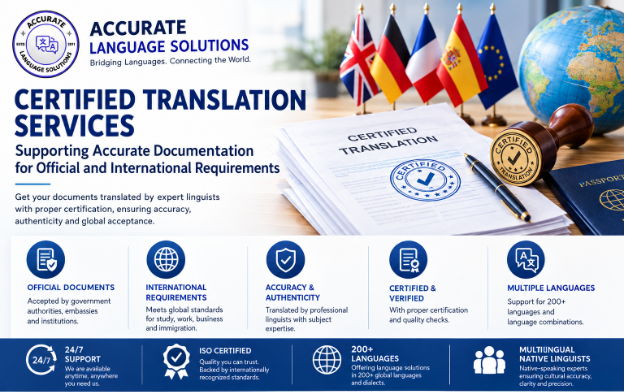
Accurate Language Solutions Private Limited provides language services for businesses and individuals requiring multilingual communication. Its service portfolio includes document translation, language translation, interpretation, transcription, voice-over, subtitling, and related language support.
For document translation assignments, the appropriate approach depends on the language pair, document category, intended use, formatting requirements, and any certification or official submission instructions. Sharing these details at the enquiry stage helps establish the scope of work and identify the relevant translation requirements.
Organizations managing recurring multilingual documentation may also benefit from consistent terminology, organized reference files, and defined review procedures across projects. These practices can support continuity when documents are updated or translated into multiple languages.
Individuals preparing documents for overseas submission should provide the destination country and the receiving institution’s instructions wherever possible. This allows the requirements to be reviewed before the translation process begins.
Supporting Clear Communication Across Languages
As international communication becomes part of everyday business and personal administration, dependable document translation remains an important requirement. Accurate terminology, appropriate subject expertise, careful proofreading, and attention to submission requirements can help ensure that translated documents communicate their intended information clearly.
Businesses, students, professionals, and individuals seeking document translation can contact Accurate Language Solutions Private Limited to discuss their language requirements and the type of documentation involved.
For Document Translation Enquiries:
Accurate Language Solutions Private Limited
Website: https://accuratelangsols.com/
Email: info@accuratelangsols.com
Phone: +91-99106 37233 | +91-9999947052
About Accurate Language Solutions Private Limited
Accurate Language Solutions Private Limited provides multilingual language solutions for business and individual requirements. Its services include translation, interpretation, transcription, voice-over, subtitling, and other language-related support for communication across languages and markets.

